Every year, your Medicare plan can change. Costs, covered drugs, the provider network, and some benefits may be different next year, even if you don't make any changes.
That's why, before December 7, it's important to review your coverage and confirm that your plan will still meet your needs in 2027.
It doesn't mean you have to switch plans. If your current coverage still works well for you, you can keep it. What matters is that you review before you decide.
When is the Medicare Annual Enrollment Period?
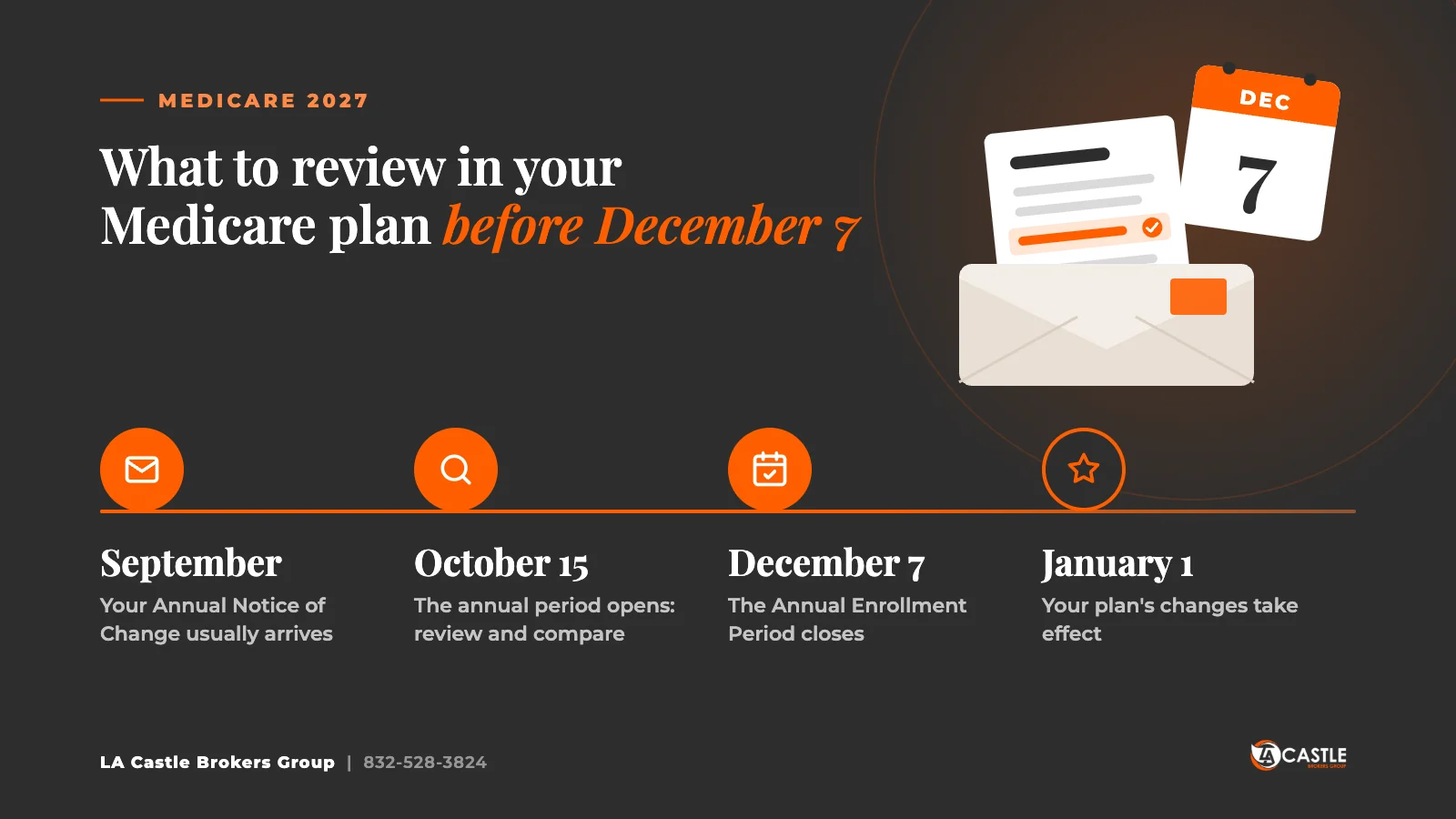
The Medicare Annual Enrollment Period runs every year from October 15 to December 7.
During this period, depending on the coverage you have, you can:
- Switch from one Medicare Advantage plan to another.
- Switch from Original Medicare to Medicare Advantage.
- Go back from Medicare Advantage to Original Medicare.
- Join, switch, or drop a Medicare Part D drug plan if you have Original Medicare.
- Change the drug coverage tied to certain Medicare Advantage options.
Changes made during this period generally start on January 1 of the following year.
Look for your Annual Notice of Change (ANOC)
If you have a Medicare Advantage plan or a drug plan (Part D), you should receive a document every fall called the Annual Notice of Change, known as the ANOC. If you have Original Medicare without a private plan, you won't receive this document — only private plans send it.
Plans usually send it in September.
This document explains the changes that will take effect in January, including changes to coverage, costs, and other important parts of your plan.
Don't ignore it.
Compare the ANOC with the coverage you use today, and pay special attention to any change that could affect you.
If you have one of these plans and didn't receive your ANOC, contact your plan directly to request it.
1. Check that your doctors are still in the network
Don't assume that because your doctor accepted your plan this year, they will next year.
Provider networks can change.
Confirm that your primary care doctor, specialists, hospitals, and other providers you use are still in the plan's network for 2027.
It's also a good idea to confirm this directly with the plan and with the provider before making a decision.
2. Review your drugs and your pharmacy
Make an up-to-date list of every drug you take and compare it with the plan's coverage for 2027.
Check:
- Whether each drug is still covered.
- Which category or tier it's in (this affects how much you pay).
- How much you could pay.
- Whether the plan requires prior authorization (approving the drug before covering it) for any of your drugs.
- Whether there are quantity limits or other restrictions.
- Whether your usual pharmacy is still in the plan's network — the cost of the same drug can change depending on the pharmacy you use, so it's worth comparing which one works best for you.
A drug that was covered this year may have different conditions or costs next year.
3. Review how much you could pay in 2027
Don't look only at the monthly premium.
Depending on your coverage, you should also review:
- Deductibles.
- Copays.
- The percentage of the bill you pay after the deductible (coinsurance).
- Drug costs.
- Hospital stay costs.
- Specialist costs.
- Out-of-pocket maximum, when it applies.
A plan with a low monthly premium won't necessarily be the one with the lowest total cost for you.
What matters is looking at how you actually use your coverage.
4. Review the extra benefits
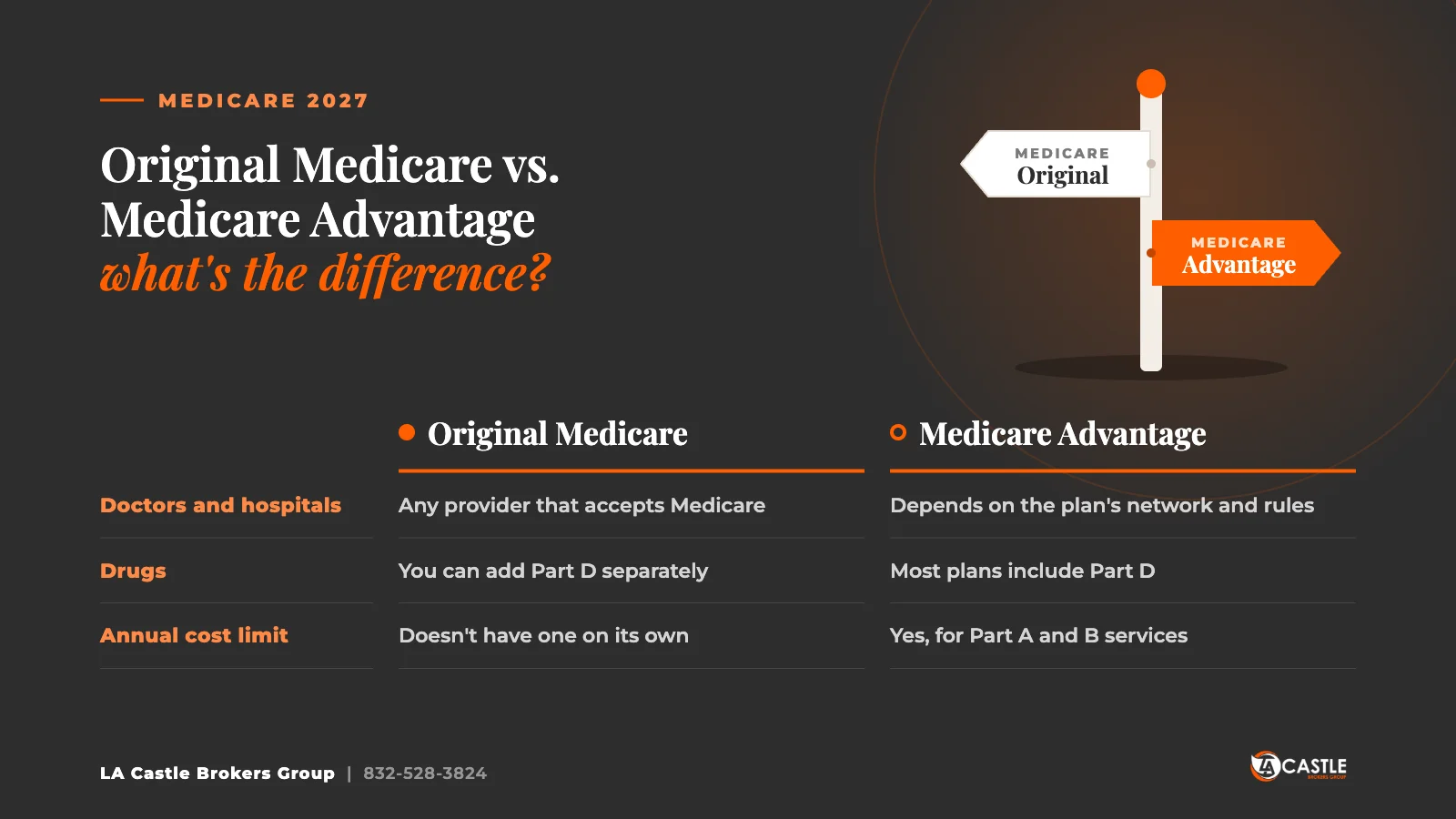
Some Medicare Advantage plans may offer extra benefits that Original Medicare doesn't cover the same way.
Depending on the plan and where you live, these may include benefits related to:
- Dental services.
- Vision.
- Hearing.
- Fitness programs.
- Transportation.
- Credits for over-the-counter (OTC) pharmacy products, such as vitamins or non-prescription medicines.
- Other supplemental benefits.
These benefits can change from year to year.
That's why it isn't enough to ask whether a plan "has dental" or "has vision." Check how much it covers, which services it includes, what its limits are, and which providers you can use.
What changes in Medicare Part D for 2027?
Medicare Part D will have important parameters for 2027 that have already been officially published by the Centers for Medicare & Medicaid Services (CMS).
Annual out-of-pocket limit: $2,400
In 2027, the annual out-of-pocket threshold for drugs covered by Part D will be $2,400.
Once you reach this limit, you no longer pay cost sharing for drugs covered by your Part D plan for the rest of the year.
Standard deductible: up to $700
The standard Part D benefit deductible will be $700 in 2027.
This doesn't mean every plan will charge a $700 deductible. Some plans may set a lower deductible or apply different conditions depending on how their coverage is designed.
National base beneficiary premium for Part D: $41.33
For 2027, the Part D national base beneficiary premium is $41.33.
It's important to understand that this does not mean every beneficiary will pay $41.33 a month.
This amount is a reference Medicare uses to calculate plan premiums. The premium you actually pay will depend on the plan you choose and, in some cases, on other factors.
How much will Medicare Part A and Part B cost in 2027?
At the time this article was updated, CMS had not yet published the final costs for Medicare Part A and Part B for 2027.
An official report Medicare uses to estimate future costs (the Medicare Trustees Report) projects that the standard monthly Part B premium could be $209.50 for 2027, compared with $202.90 in 2026.
However, this amount is still a projection and should not be considered final until CMS officially publishes the premiums, deductibles, and other costs for 2027.
That's why we always recommend checking the most recent official amounts before making a decision about your coverage.
What happens if you don't make any changes before December 7?
If your plan is still available and you don't make any changes, in many cases your coverage will continue automatically next year.
But that doesn't necessarily mean everything will stay the same.
Starting January 1, the changes your plan announced for the new year may take effect.
That's why it's important to review your coverage before deciding to keep it.
How do you know if you should compare other options?
Ask yourself these questions:
- Are my doctors and specialists still in the network?
- Are my drugs still covered?
- Did what I'll pay for my drugs change?
- Did my premium, deductible, copay, or the percentage I pay after the deductible change?
- Did any of the benefits I use change?
- Are my hospital and pharmacy still in the network?
- Did my health or my needs change this year?
If you find important changes, it may be a good time to compare the options available in your area before December 7.
Comparing doesn't mean you have to switch.
Your current plan could still be a good fit. The point of the review is for you to decide with up-to-date information.
What if I miss December 7?
December 7 is an important date, but it doesn't mean absolutely everyone has to wait until next year to make any change.
For example, if you're already enrolled in a Medicare Advantage plan, there is a Medicare Advantage Open Enrollment Period from January 1 to March 31, during which you can make certain allowed changes.
There are also Special Enrollment Periods for people who meet certain conditions, such as certain moves, loss of other coverage, or other situations set by Medicare.
The options available depend on each situation.
Review before you renew
You don't need to switch plans every year.
But it does pay to review your coverage.
An annual review can help you understand what's changing and confirm that your doctors, drugs, costs, and benefits still meet your needs.
At LA Castle Brokers Group, we can help you review your current coverage and compare the options available for 2027.
There is no cost or obligation for the review.
Or call us at 832-528-3824.
Frequently asked questions about Medicare and December 7
When is the Medicare Annual Enrollment Period?
It runs every year from October 15 to December 7. Changes made during this period take effect on January 1 of the following year.
Do I have to change my Medicare plan every year?
No. If your coverage is still available and still meets your needs, you can decide to keep it. It's a good idea to review next year's changes before making that decision.
What is the Medicare ANOC?
The Annual Notice of Change (ANOC) is the document your plan sends every fall to tell you about changes in coverage, costs, and other details that take effect in January. Only Medicare Advantage plans and drug plans (Part D) send it — if you have Original Medicare without a private plan, you won't receive this document.
What should I review before December 7?
Pay special attention to your doctors and hospitals, your drugs and pharmacies, and how much you'll pay: premiums, deductibles, copays, and the percentage you pay after the deductible, plus any extra benefits.
What happens if I miss December 7?
Your options to change coverage may be more limited. However, depending on your situation, you could have another chance to make certain changes, such as the Medicare Advantage Open Enrollment Period or a Special Enrollment Period if you qualify.
What will the Part D drug spending limit be in 2027?
For 2027, the annual Medicare Part D out-of-pocket threshold will be $2,400 for covered drugs that count toward that limit.
How much does it cost to review my plan with LA Castle Brokers Group?
Reviewing your coverage with LA Castle Brokers Group is free, with no obligation.
Important notice: LA Castle Brokers Group is an independent agency/broker licensed to offer Medicare products. We are not a government agency and are not affiliated with or endorsed by the United States government or the federal Medicare program. Plan availability, benefits, costs, and eligibility vary by plan, service area, and the beneficiary's circumstances. Some Medicare Part A and Part B figures mentioned for 2027 are projections and may change when CMS publishes the official amounts.
Official sources: Medicare.gov and the Centers for Medicare & Medicaid Services (CMS).
LA Castle Brokers Group — Houston, Texas. We speak English and Spanish.