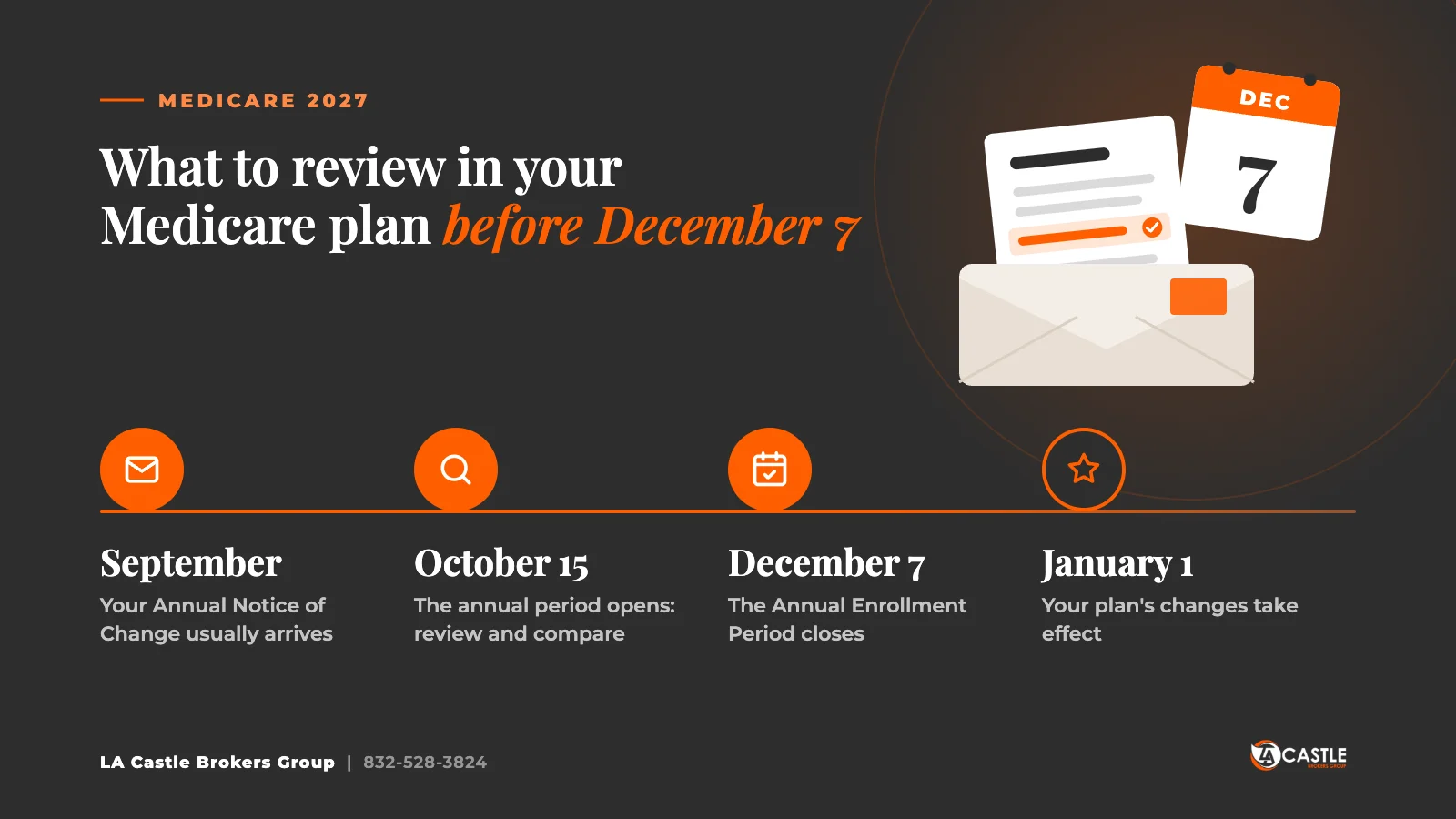
Open Enrollment for 2027 health plans has already started. This year brings important changes that could affect how much you pay for coverage, the benefits you receive, and whether you qualify for financial help.
If you currently have health insurance through the Health Insurance Marketplace, also known as Obamacare or the ACA, it is important to review your coverage before you renew it.
At LA Castle Brokers Group, we believe informed decisions are essential to protecting your health and your family's peace of mind.
Why review your health insurance for 2027?
Having a health plan in 2026 does not mean its terms will be the same in 2027.
Every year, insurers can make changes to their plans. Among the things you should review:
- Monthly premium: how much you will pay each month to keep your coverage.
- Deductible: how much you must pay for certain services before your plan starts covering them, according to the plan's terms.
- Copayments and coinsurance: how much you will pay when you receive care.
- Provider network: whether your doctors, specialists, and hospitals still participate in your plan.
- Prescription drugs: whether your prescriptions are still covered and how much they will cost.
- Tax credit: whether you still qualify for financial help and how much it will be.
Even if your plan allows automatic renewal, reviewing your options can help you avoid surprises and choose coverage that fits your needs.
What changes in the ACA Marketplace in 2027?
One of the most important changes involves the financial help that millions of people receive to pay for their health insurance.
1. Changes to premium tax credits
The enhanced premium tax credits that were temporarily available in earlier years expired at the end of 2025.
Since 2026, and again for 2027, the general premium tax credit rules apply, including the income limit of 400% of the Federal Poverty Level, known as FPL.
This means some people could receive less financial help than before, while others could stop qualifying.
However, going over the income limit for a tax credit does not necessarily mean you cannot buy a Marketplace plan. You may still have coverage options by paying the premium without that subsidy.
2. Changes to prices and benefits
Health insurance premiums can vary by insurer, geographic area, age, and the plan you select.
That is why, before renewing, it is a good idea to compare different options and not decide based only on the monthly price.
A plan with a lower premium is not always the lowest total cost for your family.
3. New rules for certain immigration statuses
Beginning in 2027, federal rules limit access to premium tax credits for certain groups of lawfully present immigrants (CMS guidance).
Among the categories of noncitizens who may continue to qualify for this assistance, if they meet the other requirements, are:
- Lawful permanent residents.
- Certain individuals classified as Cuban or Haitian entrants.
- People eligible under the Compacts of Free Association, known as COFA.
Other lawfully present immigrants may still be eligible to buy Marketplace coverage, but without receiving premium tax credits or cost-sharing reductions.
Eligibility depends on the specific immigration classification, not only on having a work permit or a Social Security number.
It is important to review each case individually before assuming that a person qualifies or has lost eligibility.
Who qualifies for the ACA tax credit in 2027?
The Premium Tax Credit (PTC) is federal financial help for people who meet certain requirements and buy eligible health coverage through the Marketplace (IRS).
Generally, to qualify you must:
- Have household income within the applicable limits, normally between 100% and 400% of the FPL.
- Be a U.S. citizen or have an immigration status that is eligible for the credit.
- Enroll in an eligible plan through the Marketplace.
- Not have access to other coverage that disqualifies you from the credit, such as certain affordable employer coverage or certain public programs.
- Meet the applicable tax rules, including those related to tax filing and dependents.
Special rules and exceptions can change this evaluation.
The amount of the tax credit does not depend only on your income. The size of your tax household, the age of the people covered, where you live, and the cost of the benchmark plans available also matter.
2027 ACA income table: Federal Poverty Level limits
The Federal Poverty Level (FPL) is used as a reference to determine eligibility for different programs and financial help.
For 2027 coverage, the FPL values published in 2026 are used (HHS/ASPE).
| People in household | 100% FPL | 250% FPL | 400% FPL |
|---|---|---|---|
| 1 | $15,960 | $39,900 | $63,840 |
| 2 | $21,640 | $54,100 | $86,560 |
| 3 | $27,320 | $68,300 | $109,280 |
| 4 | $33,000 | $82,500 | $132,000 |
| 5 | $38,680 | $96,700 | $154,720 |
| 6 | $44,360 | $110,900 | $177,440 |
Source: 2026 federal poverty guidelines, used for 2027 coverage eligibility. For households of more than 6 people, add $5,680 for each additional person. Alaska and Hawaii values are different.
How to read these limits
Imagine a family of four with an estimated annual income of $60,000.
For a household of four, 100% of the FPL is $33,000. That $60,000 is about 182% of the FPL ($60,000 ÷ $33,000), which is below the 400% limit ($132,000).
If they meet the other requirements, they could qualify for a tax credit that helps lower the monthly premium.
In addition, with income up to 250% of the FPL, and depending on their eligibility, they could receive cost-sharing reductions, such as lower deductibles and copayments, if they select a Silver plan.
Important: being within an income range does not automatically guarantee a subsidy or determine its amount on its own.
Why update your income when you renew?
One of the most common mistakes during renewal is using last year's financial information without checking whether it is still correct.
The Marketplace uses an estimate of your annual income to calculate the financial help you may receive during the year.
If your actual income changes, the tax credit you are ultimately entitled to can change as well.
For example, you should review your application when:
- You get a raise or change jobs.
- You start working for yourself.
- You lose your job or your income drops.
- You marry, divorce, or have a child.
- The number of dependents on your tax return changes.
- You start receiving additional income that must be included in the tax calculation.
An important change: you may have to repay excess tax credits
Beginning with tax year 2026, the limits that previously capped how much advance tax credit a person had to repay in certain circumstances were eliminated (IRS).
This means that if you receive more financial help than you were actually entitled to, you could have to repay the entire excess when you file your federal tax return.
That is why reporting your income correctly and updating it during the year is an essential part of keeping your coverage under control.
The calculation uses specific tax rules, including the household's Modified Adjusted Gross Income (MAGI), which does not always equal your gross salary.
If you have questions about how to report certain income, consult a tax professional.
When should you renew your health insurance for 2027?
For states that use HealthCare.gov, including Texas, the Open Enrollment dates for 2027 coverage are (HealthCare.gov):
- November 1, 2026: Open Enrollment begins.
- December 15, 2026: general deadline to select coverage that starts on January 1, 2027.
- January 15, 2027: Open Enrollment for 2027 coverage ends.
Applications and changes made after December 15 and through January 15 will generally have coverage starting February 1, 2027.
Outside this period, you will normally need to qualify for a Special Enrollment Period to enroll or change plans, except where exceptions apply.
Five tips before you renew
- Review your estimated annual income for 2027. Do not automatically use the income you reported in prior years.
- Confirm your tax household information. Check dependents, marital status, and other relevant details.
- Compare the available plans. Review costs, benefits, doctors, hospitals, and prescription drugs.
- Check your eligibility for financial help. Requirements and amounts can change from one year to the next.
- Ask for guidance before you decide. Understanding your options can help you avoid mistakes and choose suitable coverage.
Conclusion: renewing is a chance to decide better
The 2027 Marketplace changes make reviewing your coverage especially important.
Knowing the income limits, understanding who qualifies for tax credits, and keeping your information up to date can help you make more informed decisions about your health protection.
At LA Castle Brokers Group we support families through this process, explaining their options clearly and responsibly. You can learn more about the plans we offer on our ACA health insurance page.
Have you reviewed your 2027 health plan yet?
Contact our team to schedule a review of your coverage and learn about the alternatives available for your needs. There is no cost or obligation for the review.
Or call us at 832-528-3824.
Frequently asked questions about ACA renewal 2027
Can I renew my plan if my income went up?
Yes. A higher income does not necessarily mean you will lose your health insurance. However, it could change or eliminate your tax credit, depending on the new income and the other eligibility requirements.
What happens if my income is above 400% of the FPL?
As a general rule, you will not be able to receive the premium tax credit if your household income is above that limit in 2027. You may still be able to buy Marketplace coverage without that financial help.
Can I switch insurers when I renew?
Yes. During the Open Enrollment period you can compare options and select a different plan available in your area.
What happens if my income drops during 2027?
You should report the change to the Marketplace. Depending on the circumstances, you could qualify for a different amount of financial help or for other coverage programs.
Do I have to renew my ACA plan every year?
Some plans may renew automatically, but that does not guarantee you will keep the same premium, benefits, or financial help. That is why it is a good idea to review your coverage and update your application information every year.
How much does it cost to have my plan reviewed with LA Castle Brokers Group?
Reviewing your coverage with LA Castle Brokers Group is free and carries no obligation.
Important notice: This article is for educational purposes and is not legal, tax, or financial advice. LA Castle Brokers Group is a licensed independent agency/broker; it is not a government agency or the official Health Insurance Marketplace site (HealthCare.gov). Eligibility, tax credits, and benefits depend on individual circumstances and on Marketplace determinations. We do not offer every plan available in your area. The information reflects the rules in effect as of November 14, 2026 and may change; always check the latest official notices, particularly on immigration eligibility and verification processes.
Sources: CMS, 2027 Marketplace plans and dates · CMS, 2027 noncitizen eligibility · IRS, Premium Tax Credit · IRS, Q&A · KFF, what to watch in 2027 Open Enrollment · HHS/ASPE, poverty guidelines.
LA Castle Brokers Group — Houston, Texas. We speak English and Spanish.