What we don't know costs us too
Most families who don't have life insurance never actually decided against it: they kept putting it off because of ideas they never questioned. According to the 2026 Insurance Barometer Study by LIMRA and Life Happens, life insurance is still one of the least understood financial products, and what holds people back is confusion, not a lack of interest.
Among Hispanic Americans, the gap is even wider. The 2025 study found that only 40% of Hispanic Americans have life insurance, the lowest rate of any ethnic group. And in many homes, it's a topic no one talks about: in the 2022 study, 21% of Hispanic Americans said a major reason they don't have life insurance, or don't have more, is that they don't like thinking about death.
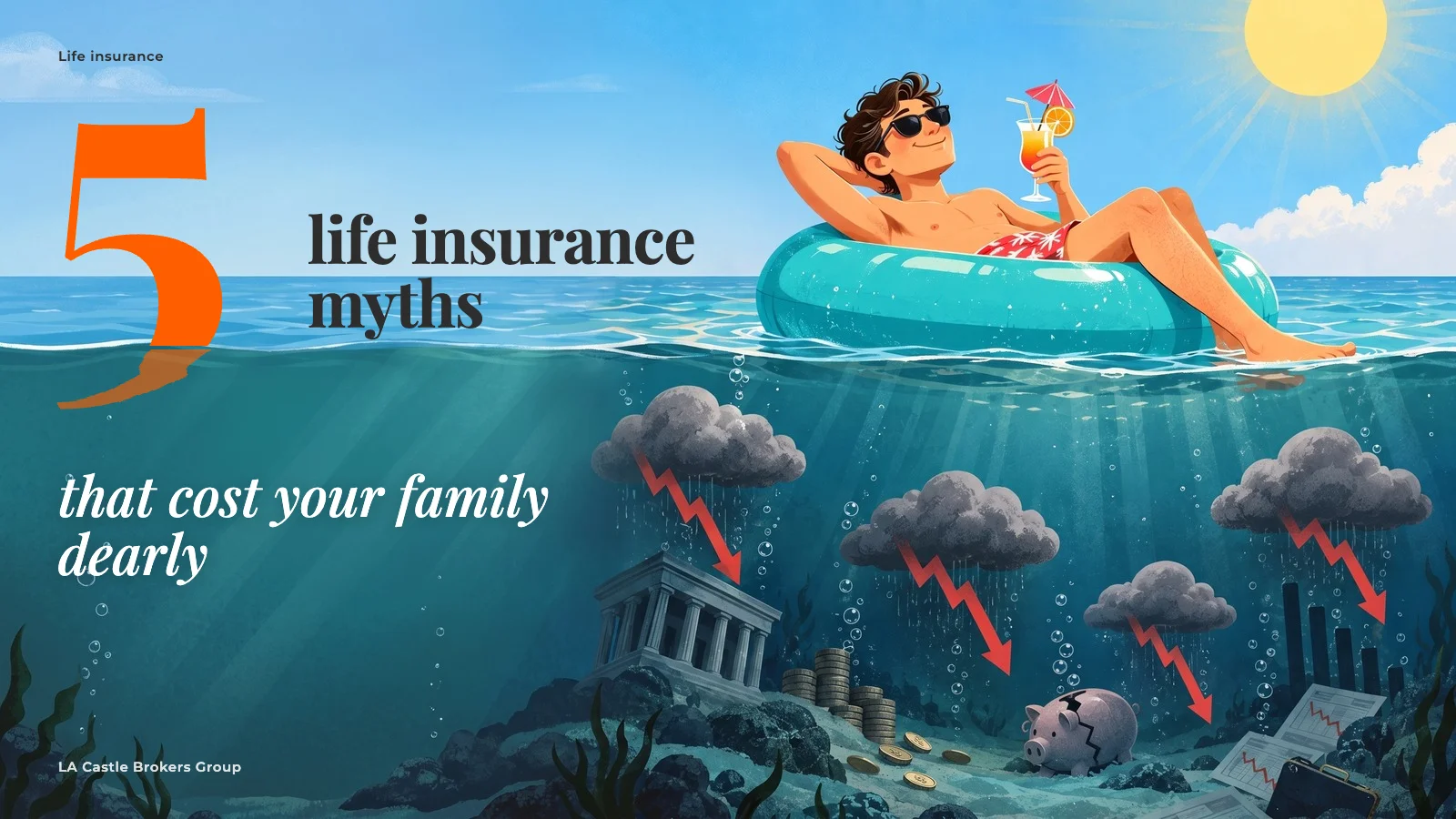
Here we look at the five myths we hear most often in our conversations with families in the Houston area. For each one, we tell you what the myth says, what the reality is, and what you can do.
Myth 1: "Life insurance is too expensive"
It's one of the most common myths, and one that leaves more families unprotected than almost any other. In LIMRA's 2024 study, 44% of Hispanic Americans said life insurance is too expensive, but more than 7 in 10 (72%) overestimated the real cost of a term policy.
And it isn't just Hispanic Americans. In the 2025 study by LIMRA and Life Happens, healthy adults ages 18 to 30 estimated that a term policy cost 10 to 12 times more than it actually does.
The reality. The price depends on your age, your health, the amount of coverage, and the type of policy. Term life insurance for a young, healthy person usually costs less than many people imagine. Also, with many level-premium term policies, the payment stays the same for the term you choose, as set out in the contract. Keep in mind, though: term coverage ends when the term is over, and renewing it afterward usually costs considerably more.
What you can do. Don't decide based on a number you imagined. Ask for a quote with your real information and compare. Remember that any quote is an estimate: the final premium is set by the insurance company after it reviews your application and your health. Age is one of the factors in the price, so it's worth learning about your options early and deciding calmly.
Myth 2: "Life insurance is only for covering the funeral"
Covering the funeral matters, and for many families it's the first reason to buy insurance. A Life Happens and LIMRA report with 2022 data found that nearly 7 in 10 Hispanic Americans with life insurance (69%) cite covering burial and final expenses as a major reason for having it. The problem is when protection stops there: in 2024, 26% of Hispanic Americans believed that's all life insurance is for.
The reality. The funeral is paid once. Household expenses keep coming every month. The National Funeral Directors Association calculated a median cost of $8,300 for a funeral with a casket, viewing, and burial in 2023, not counting the cemetery or headstone. But in LIMRA's 2024 study, 46% of Hispanic families said they would face financial hardship in less than six months if the primary wage earner were gone.
A well-planned life insurance policy can pay for the funeral and also cover rent or the mortgage, debts, groceries, and the kids' education while the family gets back on its feet.
What you can do. Think of your insurance as the backup that would replace your income, not just as a way to pay for one service. If you want to calculate how much your family would need, we explain how in How much life insurance does your family need?.
Myth 3: "I already have insurance through work, and that's enough"
The insurance your employer offers is a good benefit, and if the company pays for it, it makes sense to take advantage of it. But for many people it's their only protection: according to the 2025 Insurance Barometer Study by LIMRA and Life Happens, 1 in 4 people with life insurance (26%) have only the coverage they get through work.
The reality. That insurance has two important limits:
- It's usually not much. Basic coverage through work generally equals one or two times your annual salary, according to the Texas Department of Insurance. For a family with a mortgage and young kids, it often falls short.
- It isn't yours. It generally ends when you leave that job, whether you quit, are let go, or retire. Many plans let you convert it into an individual policy, but you have to ask quickly: in Texas, the law gives you 31 days after leaving the job, and it's almost always at a higher premium.
What you can do. Check with HR how much your policy covers and what happens if you change jobs. Use that insurance as a supplement, and have a policy of your own that stays with you no matter where you work. In How much life insurance does your family need?, we show you how to factor in your insurance through work when calculating how much coverage you need.
Myth 4: "I'm young and healthy, so I don't need it yet"
Many young people think life insurance is for older people. Yet in LIMRA's 2024 study, Gen Z had the highest share of any generation saying they need life insurance or more coverage: 49%.
A real story
Two years ago, I met with a client in her early 30s and her husband. She was healthy and led an active life. We explained how life insurance works and that, given her age and health, this was the best time for her to apply.
Her answer was very honest: "We're young and healthy, so we don't need it yet." We respected her decision.
A few months ago, she called me, worried. Her doctor had ordered more tests, and she wanted to pick up the conversation again. Soon after came the diagnosis she feared: cancer. The options she had two years earlier were no longer available in the same way. With a diagnosis like that, a traditional application is usually postponed or declined, and what's left generally offers less coverage at a higher cost.
I'm not sharing this to scare you. I'm sharing it because she was right about one thing: she was young and healthy. That's exactly why it was the best time for her to apply.
We're sharing this story with her permission and have changed some details to protect her privacy.
The reality. Being young and healthy isn't a reason to wait. It's the best reason to start, for three reasons:
- The price is based on your age and health when you apply. The younger and healthier you are when you apply, the more likely the insurance company is to offer you a lower premium.
- Health changes without warning. A diagnosis of high blood pressure, diabetes, or another condition can raise the price or make approval harder later on.
- Responsibilities arrive sooner than you think. A loan with a cosigner, a car in both your names, a baby on the way, or parents who depend on you.
What you can do. If someone already depends on you or has cosigned a debt with you, you already have a reason. According to the Texas Department of Insurance, term insurance is the simplest and least expensive option, and permanent insurance costs more because it covers your whole life.
Myth 5: "If I don't work outside the home, I don't need it"
This myth mostly affects moms. In LIMRA's 2024 study, women were 11 percentage points less likely than men to have life insurance (46% vs. 57%), the widest gap in the study's 14-year history.
The reality. The person who takes care of the home and the kids doesn't get a paycheck, but their work has enormous value. Insure.com's annual index estimated that a mom's unpaid work at home was worth $145,235 a year in 2025.
If that parent were gone, the family would have to pay for child care, school transportation, meals, and cleaning. And the parent who works outside the home might have to cut back hours to care for the kids, which also reduces income.
What you can do. Calculate how much it would cost each year to pay for those tasks and use that as the basis for their coverage. We explain it step by step in How much life insurance does your family need?, in the section on when one of you stays home.
What you should expect from a good agent
There's a sixth obstacle that isn't a myth but a real experience: distrust. LIMRA found in 2024 that Hispanic Americans are more distrustful of agents and insurance companies than the general population.
A good agent explains first and recommends second. They show you options from several insurance companies, tell you what each policy doesn't cover, and respect your time to decide. They make clear that any quote is an estimate until the insurance company reviews your application, and if you already have a policy, they don't ask you to cancel it before the new one is approved and in force. If you feel rushed or pressured, that's not how it should be done.
Your next step
If any of these myths sounded familiar, you're not alone. At LA Castle Brokers Group, we believe understanding comes first and deciding comes after. If you'd like to work through your questions calmly, we're happy to talk with you, with no obligation.
Or call us at 832-528-3824.
Frequently asked questions
At what age does it make sense to buy life insurance?
There's no single age. What matters most is whether someone depends on you: your partner, your kids, your parents, or someone who cosigned a debt with you. Because the price is based on your age and health when you apply, doing it while you're young and healthy usually gives you access to lower premiums. Even so, the final premium is set by the insurance company after it reviews your application.
What happens to my life insurance through work if I'm let go?
Generally, coverage ends when you leave the job, regardless of the reason. Many plans let you convert it into an individual policy: in Texas, the law gives you 31 days after leaving the job to request it, and it's almost always at a higher premium. Ask HR what options your plan offers before your last day.
Can I get life insurance if I already have a health condition?
In many cases, yes. It depends on the condition, how well controlled it is, and each insurance company: some accept the application at a higher premium, and others postpone it. There are also policies with few health questions, but they usually offer less coverage, at a higher cost, and with an initial period during which the death benefit is limited. An independent agent can compare several insurance companies for your situation; approval always depends on each company's review.
Does life insurance pay if I die from an illness?
Generally, yes: a life insurance policy that's in force pays the death benefit whether the death is caused by illness or by accident. There are two rules worth knowing. During the first two years, the insurance company can review the application and deny payment if it finds important information that was false or left out; that's why it's key to answer it truthfully. And many policies exclude suicide during that same initial period. Keep in mind: accidental death insurance isn't the same thing, because it pays only if the death is caused by an accident. The exact details depend on your contract.
Disclaimer. This article is educational and does not constitute legal, tax, or financial advice. Any premium is an estimate: the final cost, coverage, and approval depend on your age, your health, and each insurance company's review. Term insurance covers a fixed period and ends when that period is over.
Sources:
- Texas Department of Insurance, Life insurance guide (English version; Spanish version)
- Texas Department of Insurance, Life insurance tips
- Texas Insurance Code, Chapter 1131, Group Life Insurance and Wholesale, Franchise, or Employee Life Insurance, Section 1131.110
- LIMRA, Life Insurance Through the Consumer Lens (Insurance Barometer 2026)
- LIMRA, Adults Age 30 and Younger Overestimate Life Insurance Cost by 10–12 Times (Insurance Barometer 2025)
- LIMRA, 2025 Insurance Barometer Study
- LIMRA, Hispanic Americans and Life Insurance: Bring Family to the Conversation (Insurance Barometer 2025)
- LIMRA, Hispanic Americans Report Greatest Life Insurance Need (Insurance Barometer 2024)
- LIMRA, U.S. Life Insurance Need Gap Grows in 2024 (Insurance Barometer 2024)
- LIMRA, 2024 Insurance Barometer: Securing the Future (infographic)
- LIMRA, Addressing the Coverage Gap Among Hispanic Americans (Insurance Barometer 2022)
- Life Happens, The Life Insurance Need Gap for Hispanic Americans
- National Funeral Directors Association, 2023 NFDA General Price List Study
- Insure.com, The Mother's Day Index (2025)